Temporality in Computing and Design
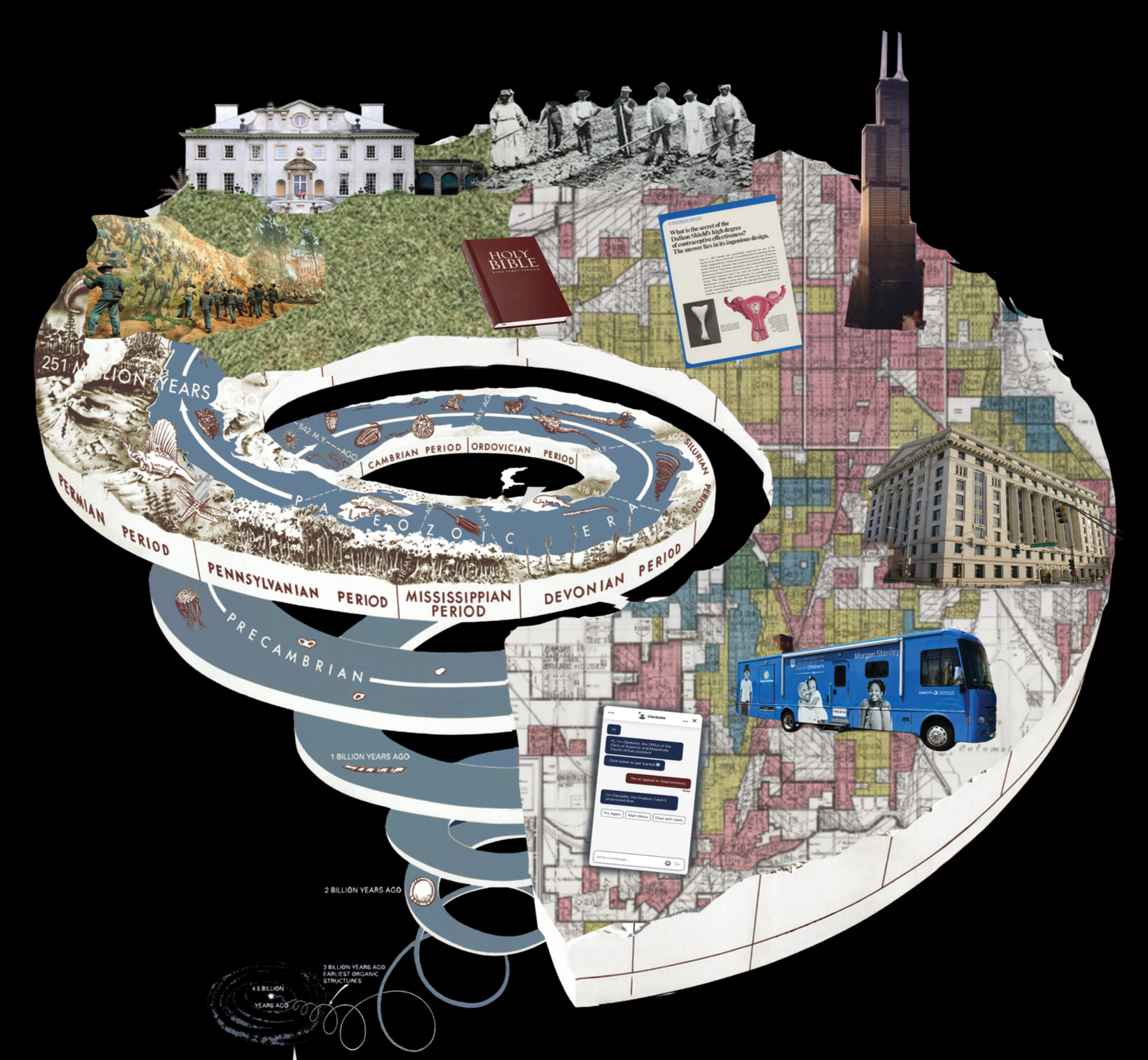
A collage combining the sedimented temporalities of Wieczorek and Tran’s field work for the presentation of Whose Time Counts? (Wieczorek & Tran, et al., CHI 2026).
Related Publications
Catherine Wieczorek, Sylvia Janicki, Annabel Rothschild, Carl DiSalvo, and Shaowen Bardzell. 2026. Speculating the Archive: Research through Design with Incomplete Histories. In Proceedings of the 2026 Designing Interactive Systems Conference (DIS '26). Association for Computing Machinery, New York, NY, USA, 2140–2155. https://doi.org/10.1145/3800645.3812795
Wieczorek, C., Tran, A., Lin, C. K., Forlano, L., DiSalvo, C., & Bardzell, S. Whose Time Counts? Temporal Arrangements in Sociotechnical Infrastructures. CHI '26. https://doi.org/10.1145/3772318.3790780
Wieczorek, C., Lin, C. K., & Bardzell, S. Making Sense of Trauma Over Time: Interweaving Feminist Temporalities to Understand Histories. PACM HCI, 9(2), CSCW130. https://doi.org/10.1145/3711028
Wieczorek, C., Biggs, H., Payyapilly Thiruvenkatanathan, K., & Bardzell, S. Architecting Utopias: How AI in Healthcare Envisions Societal Ideals and Human Flourishing. CHI '25. https://doi.org/10.1145/3706598.3713118
Wieczorek, C., & Forlano, L. Reimagining Temporality: Exploring the Intersection of Time and Trauma in Design Research. DRS 2024. https://doi.org/10.21606/drs.2024.1032
Temporality has become a central concern in HCI and design research, where time is understood not as a neutral backdrop but as something produced, negotiated, and distributed through sociotechnical systems. Throughout my doctoral work, I have studied temporality in computing and design, both as something to make visible and something to examine within my field sites.
In Reimagining Temporality (Wieczorek & Forlano, DRS 2024), I examine the limits of journey maps, diary studies, and temporal probes for articulating nonlinear experience, arguing for feminist temporality and crip time as framings that accommodate cyclical, pluriversal, and relational accounts of time. My design work enacts these framings. In Grid(a) Temporali, a folded, non-sequential map of Great Lakes shipwrecks produces ambiguity and doubt as experiential qualities of artifacts usually taken as factual (Wieczorek et al., DIS 2026). With public library workers, a toolkit of resource cards, storytelling worksheets, and participatory diagramming let staff trace a single incident as it moved through the branch at different speeds: the youth-services librarian met it as it happened, a parent arrived hours later, and the director encountered it days afterward in an incident report. Laying this out together showed that the timing of an arrival was not incidental but shaped what each person could do about it.
As a lens, temporality shows how infrastructures distribute burden unevenly. Whose Time Counts? (Wieczorek & Tran, et al., CHI 2026) conceptualizes infrastructures as stratified formations in which earlier allocations of power become materially and procedurally embedded, and names two temporal arrangements, compression and gaps, across eviction filings in Atlanta and sexual healthcare in Chicago. Making Sense of Trauma Over Time (Wieczorek, Lin, & Bardzell, CSCW 2025) interweaves feminist temporalities to reframe trauma as historically and communally felt across generations rather than as a discrete event. Architecting Utopias (Wieczorek et al., CHI 2025) turns to projected futures, using Levitas's forms of utopian thinking to examine how AI healthcare products embed societal ideals while reproducing hype cycles.
This ongoing design research practice moves between making and analysis: the forms I make surface temporal conditions that analysis alone would leave implicit, and the analytic vocabulary I develop shapes what is visible in the field site.
2017–2025
Field work: Atlanta case was lead and written by Dr. Anh-ton Tran; the Chicago case was developed and written by Catherine Wieczorek.
Related Publications:
Wieczorek, C., Tran, A. T., Lin, C. K., Forlano, L., DiSalvo, C., & Bardzell, S. (2026, April). Whose Time Counts? Temporal Arrangements in Sociotechnical Infrastructures. In Proceedings of the 2026 CHI Conference on Human Factors in Computing Systems (pp. 1-18). doi.org/10.1145/3772318.3790780